



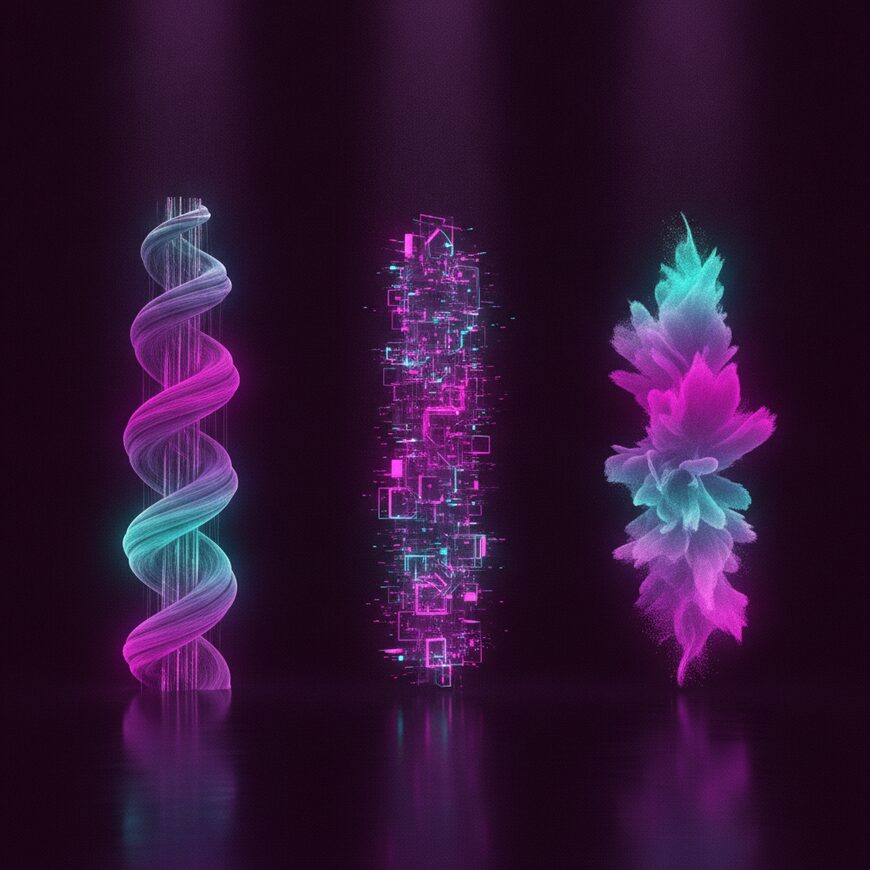
Flux, Midjourney, and Stable Diffusion all turn text into images, but they read that text in three genuinely different ways. A prompt that sings in Midjourney falls flat in Stable Diffusion. A natural-language description that Flux loves confuses an SD 1.5 checkpoint. If you have ever copied a prompt between tools and wondered why the result fell apart, this is why. The deciding factor in flux vs Midjourney vs Stable Diffusion is not which model is “best” — it is how each one wants to be talked to.
Here is what actually changes between them, with the same scene written three ways so you can feel the difference.
Flux vs Midjourney vs SD: the core split #
Step back from the flux vs Midjourney question for a second, because the real divide is tokens versus prose, and all three models fall somewhere on that line. Stable Diffusion sits at one end. It reads a comma-separated list of tokens, weights them, and lets you push individual concepts with (token:1.3) syntax. You get surgical control — weights, negative prompts, prompt scheduling — at the cost of having to think like the model. It rewards structure and punishes rambling.
Flux sits at the other end. It was built to follow natural language, so it reads flowing descriptive prose and tracks relationships between elements unusually well. Long, coherent sentences that would dilute a Stable Diffusion prompt are exactly what Flux wants. It is notably strong at prompt adherence and at rendering legible text, and it generally needs no negative prompt at all.
Midjourney sits in the middle, with a personality. It takes comma-separated phrases like Stable Diffusion, but it reads them loosely and applies a strong house aesthetic — everything comes out a little more polished, more dramatic, more “designed” than you asked for. It also uses double-dash parameters (--ar, --stylize, --chaos) to control output rather than in-prompt weighting.
The same scene, three ways #
One subject — a lone lighthouse on a storm-battered cliff — written natively for each model.
Stable Diffusion (weighted tokens)
Positive:
(lighthouse on a rocky cliff:1.2), stormy sea, crashing waves,
dark clouds, (dramatic lighting:1.3), sea spray, moody atmosphere,
cinematic, highly detailed, sharp focus

Negative:
lowres, blurry, deformed, watermark, text, oversaturated

Steps: 30  |  Sampler: DPM++ 2M Karras  |  CFG: 7  |  Size: 1216x832
Midjourney (phrases + parameters)
dramatic lighthouse on a storm-battered cliff, crashing waves
and sea spray, dark brooding clouds, cinematic atmosphere,
moody color grade --ar 3:2 --stylize 250
Flux (natural-language prose)
A weathered stone lighthouse stands alone on a rocky cliff as
a violent storm rolls in off the sea. Massive waves crash
against the rocks below, throwing spray into the air, while
dark clouds gather overhead and the last grey light catches
the lighthouse's white tower. Cinematic, moody, and atmospheric,
with a sense of isolation and scale.
Read those back to back and the philosophy is obvious. Stable Diffusion is a control panel. Midjourney is a brief to a stylish art director who will add flair. Flux is a paragraph to a literal, attentive illustrator.
How each handles the hard parts #
Prompt adherence
If you need the model to do exactly what you said — three objects, specific spatial relationships, a particular pose — Flux and DALL·E-class models lead, because their language understanding tracks “A to the left of B, not touching C.” Stable Diffusion can get there with weighting and regional tricks but takes more effort. Midjourney is the loosest; it interprets rather than obeys, which is wonderful for vibe and frustrating for precision.
Text in images
Flux renders legible words reliably, which is a real differentiator for posters and mockups. Stable Diffusion struggles with text by default and usually needs a specialized model or post-work. Midjourney has improved but remains inconsistent for anything beyond a short word or two.
Style and aesthetics
Midjourney wins on out-of-the-box beauty. Type a half-decent phrase and it hands back something that looks professionally art-directed. That is the whole appeal — and also the limitation, because bending it away from its house look takes deliberate effort. Stable Diffusion is the opposite: neutral by default, but with thousands of community checkpoints and LoRAs you can dial in nearly any style precisely. Flux lands in between — clean and modern out of the box, increasingly flexible as its ecosystem grows.
Control and negatives
Stable Diffusion is the clear winner on raw control: negative prompts, attention weighting, scheduling, ControlNet, inpainting, regional prompting. Flux generally skips negative prompts entirely and leans on clearer positive description. Midjourney offers --no for exclusions and parameters for tuning, but nothing as granular as the SD stack.
Which one for which job #
- Maximum control, local and free, any style via checkpoints: Stable Diffusion. Best when you want to own the pipeline and tune every variable.
- Best-looking results with least effort, strong aesthetic: Midjourney. Best for mood boards, concept art, and anything where house polish is a feature.
- Strict prompt adherence, legible text, natural-language briefs: Flux. Best when the image has to match a specific description and contain readable words.
Don’t reuse the same prompt across all three and judge them on it. That only tells you which model happens to like your default writing style. Write each prompt the way that model wants to be written, then compare.
Translating a prompt between models #
Moving a prompt across tools is mostly about reshaping the same intent:
- SD to Flux: stitch your comma tokens into flowing sentences, drop the weights and quality tags, and let description carry the load. Delete the negative prompt.
- Flux to SD: break the prose into comma-separated tokens, add a negative prompt, and weight the two or three concepts that matter most.
- Either to Midjourney: condense to vivid comma-separated phrases, cut the quality-tag clutter, and move technical controls into parameters like
--arand--stylize.
The takeaway on flux vs Midjourney vs Stable Diffusion is simple: there is no universal best, only a best fit for the job and a right way to phrase the prompt for each engine. Learn all three dialects and you stop being locked into one tool’s strengths. The prompt generator at ArtPrompts Generator can output the same idea in each model’s native style, so you can paste it where you need it and skip the translation step entirely.

Leave a Reply